Why Scaling Your Company Doesn't Scale Your Authority (And What That Costs You)
By Karan Kashyap · Founder, Stay Noisey
Operational scaling and authority scaling are two completely separate processes but most CEOs treat them as one. They build the company, grow the team, deepen the complexity, and assume the market updates its understanding of them accordingly. It doesn't. The market's version of you is based on the last clear signal you sent. For most CEOs who've spent years heads-down building, that signal is years out of date.
This creates what I call Signal Loss: a structural gap between institutional expertise and external market recognition. It's not a branding issue and it's not a visibility problem in the way most people use that term. It's an infrastructure failure where the market lacks the information it needs to price you accurately, and you don't notice until the cost becomes impossible to ignore.
The distinction matters because the solution isn't more content, more posts, or more self-promotion. The solution is understanding that authority requires its own infrastructure, separate from the operational infrastructure you've already built, and that the longer you delay building it, the wider the gap becomes.
What Actually Changes When a Company Scales
Between £3M and £100M in revenue, a CEO's operational world transforms completely. The team grows. Decision-making becomes distributed. Systems replace improvisation. The CEO moves from doing everything to leading everything.
Inside the company, credibility compounds naturally through observed performance. The senior team has watched the CEO operate under pressure. They've seen the judgement calls land. They trust the process because they've witnessed it firsthand. Nobody in the building needs the CEO to prove themselves.
That internal environment creates a dangerous false equivalence. Because credibility is accumulating internally, it feels like it should be accumulating everywhere. The daily experience of being trusted, consulted, and deferred to by a growing team creates a psychological signal that says: the world sees what I've built.
It doesn't. Internal credibility and external authority operate on completely different mechanisms. Internal credibility is built through proximity and repeated observation over time. External authority requires deliberate signal transmission. One happens organically. The other requires infrastructure.
Why External Signal Doesn't Update Automatically
I first identified this pattern during my time doing psychometric interviewing work at Gartner. I was spending hours with senior leaders, extracting how they thought, how they made decisions, what frameworks they operated from. Consistently, I'd sit across from someone running a complex operation with genuine strategic depth, and then I'd look at what the market actually knew about them. There was almost no relationship between the two.
The leaders who'd been heads-down scaling were the worst offenders. They'd built extraordinary capability inside the company and assumed the market was keeping pace. It never was. That gap between what I could extract in a two-hour interview and what the market could observe from the outside became the entire foundation of how I think about authority as an infrastructure problem.
The market's version of you is based on the last clear signal you sent. For most CEOs who've spent years heads-down building, that signal is years out of date.
The mechanism is straightforward. External perception is built from observable signal. When a CEO is in the early stages of a company, they're typically more visible. They're raising money, speaking at events, giving interviews, actively projecting their vision into the market. That creates an initial signal.
Then scaling happens. The CEO's attention turns inward. The operational demands are genuine and all-consuming. External communication drops to near zero. The market doesn't receive updated information, so it doesn't update its model.
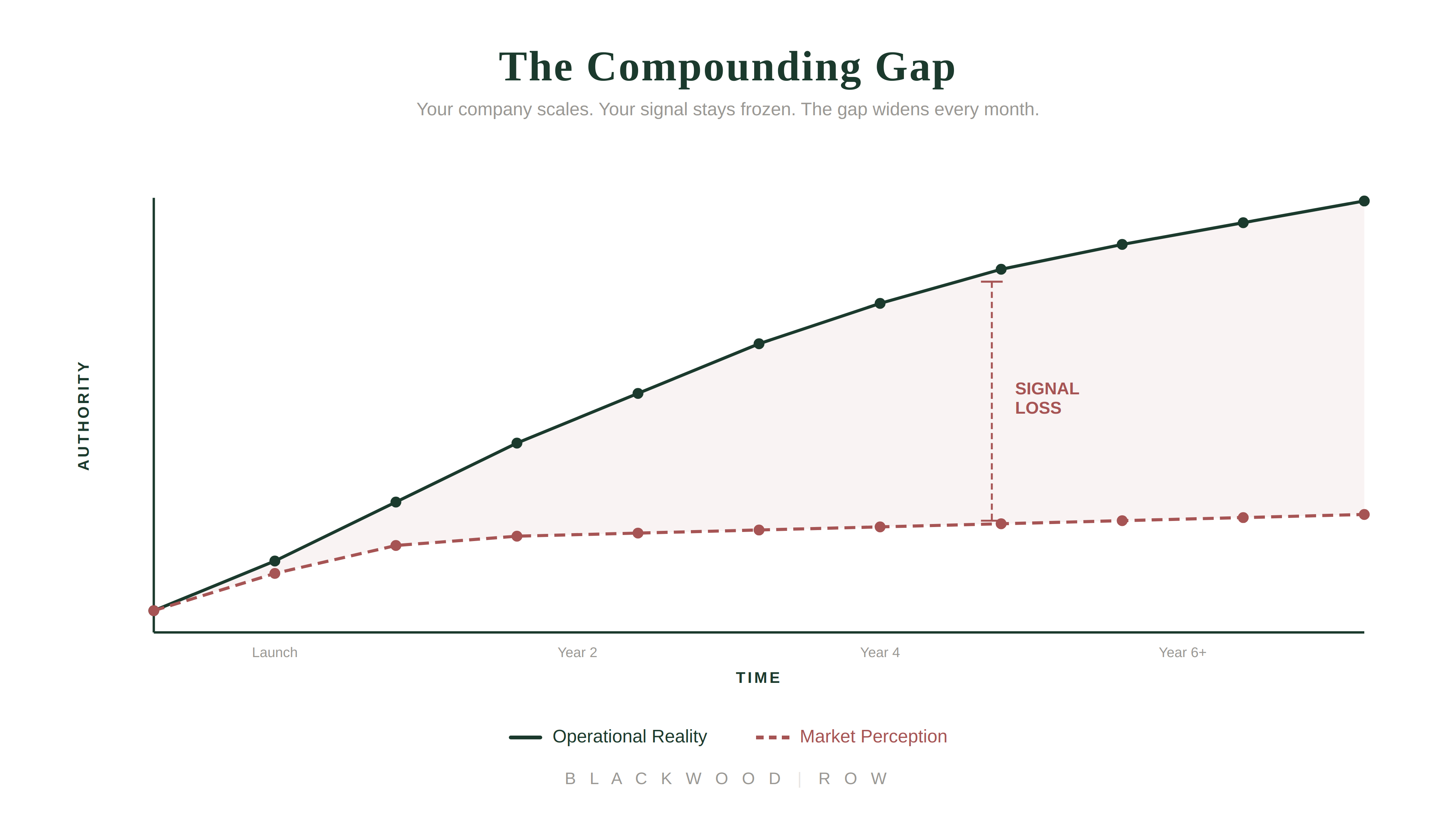
The result: the market's perception of the CEO freezes at the point where active signal transmission stopped. Early-stage founder identity becomes a ceiling. The market still sees who you were at launch, not who you are now. A CEO who has evolved from scrappy founder to sophisticated institutional leader is still being evaluated against a three-year-old mental model.
Research from Weber Shandwick and KRC Research found that global executives attribute 63% of their company's market value to their company's overall reputation, and estimate that 44% of their company's market value is attributable to the reputation of their CEO [1][2]. The reputation isn't a soft asset. It has a direct, measurable relationship with how the market prices the company and its leadership.
The False Sense of Security That Operational Success Creates
Revenue is growing. The team is strong. Clients are happy. Every internal metric confirms the company is performing. This creates a feedback loop where the CEO receives constant validation that things are going well, which masks the external gap entirely.
The 2024 Edelman-LinkedIn B2B Thought Leadership Impact Report surveyed nearly 3,500 management-level professionals and found that nearly three quarters of decision-makers say that an organisation's thought leadership content is a more trustworthy basis for assessing its capabilities and competencies than its marketing materials and product sheets [3]. That statistic has a sharp edge for CEOs with no external signal at all. It means the people evaluating you, investors, potential hires, partners, acquirers, are forming judgements based on what they can find. When they find nothing, they don't give you the benefit of the doubt. They move on, or they discount.
The internal validation loop is particularly dangerous because it's self-reinforcing. Every successful quarter, every strong hire, every satisfied client makes the CEO less likely to notice the external gap. Success breeds comfort, and comfort breeds complacency about the one dimension of the business that isn't being actively managed.
When Does the Cost Actually Become Visible?
The gap between internal reality and external perception doesn't announce itself gradually. It surfaces in specific, high-stakes moments where the CEO suddenly needs the market to understand what they've built, and discovers it can't.
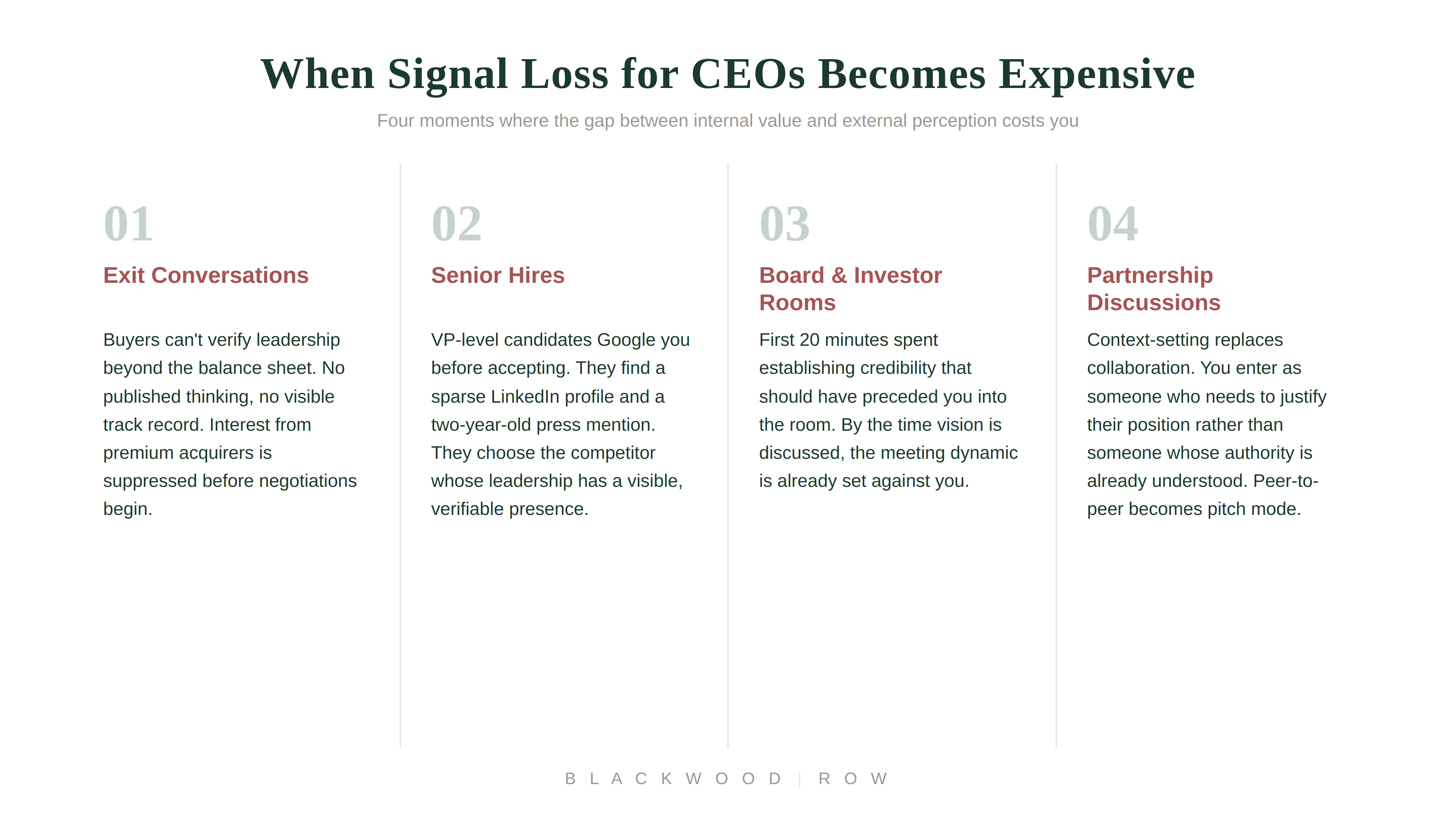
Exit conversations. Consider a CEO running a £40M professional services firm who is 18 months from a planned exit. Operationally, the company is clean. Strong margins, solid team, recurring revenue. When the advisory firm runs the initial market sounding, the feedback is consistent: buyers can't find evidence of the CEO's leadership beyond the company's own website. No published perspective, no visible track record of strategic thinking, nothing that signals this is a leader worth retaining post-acquisition. The advisory firm flags it directly. The absence of external signal is suppressing interest from the buyers most likely to pay a premium. Those buyers are forming a view of leadership quality based on what they can observe quickly. When they observe nothing, they price accordingly.
This scenario plays out regularly in mid-market exits. Acquirers conduct due diligence on the leadership team, not just the balance sheet. Bain & Company's due diligence research emphasises that successful acquirers consider integration implications during the due diligence phase, not afterward, and that the best companies identify critical issues that underpin the value and build an early integration thesis [4]. When a CEO has no external signal infrastructure, the acquirer's assessment of leadership quality depends entirely on what can be surfaced during a compressed evaluation window. That's a structurally weak position.
Internal credibility and external authority operate on completely different mechanisms. One happens organically. The other requires infrastructure.
Senior hires who choose a competitor. A VP-level candidate receives two comparable offers. Before deciding, they do what any senior professional does: they research the leadership. They search for the CEO, the founder, the executive team. At one company, they find published perspectives, a documented point of view on the industry, evidence of strategic thinking. At the other, they find a sparse LinkedIn profile and a two-year-old press mention from a funding round. The offer terms might be identical, but the decision often isn't. The 2025 Edelman-LinkedIn B2B Thought Leadership Impact Report found that high-quality thought leadership serves as a mechanism for building credibility with hidden buyers and drawing them into the conversation [5]. Senior candidates are exactly this kind of stakeholder.
Board and investor conversations. A CEO walks into a board meeting or investor discussion and has to establish credibility from a standing start. There's no prior context, no pre-installed understanding of their perspective. Every claim requires explanation. Every strategic position requires justification from first principles. The CEO spends the first twenty minutes of a sixty-minute meeting building the foundation that should have been in place before they entered the room.
Partnership discussions. A potential strategic partner invites the CEO to a conversation. The first fifteen minutes are consumed by context-setting, explaining background, establishing credentials, justifying why this conversation should be taken seriously. By the time the actual discussion begins, the dynamic has already been set. The CEO entered as someone who needed to prove they belonged in the room, rather than someone whose presence was already understood.
The Internal vs External Split in Practice
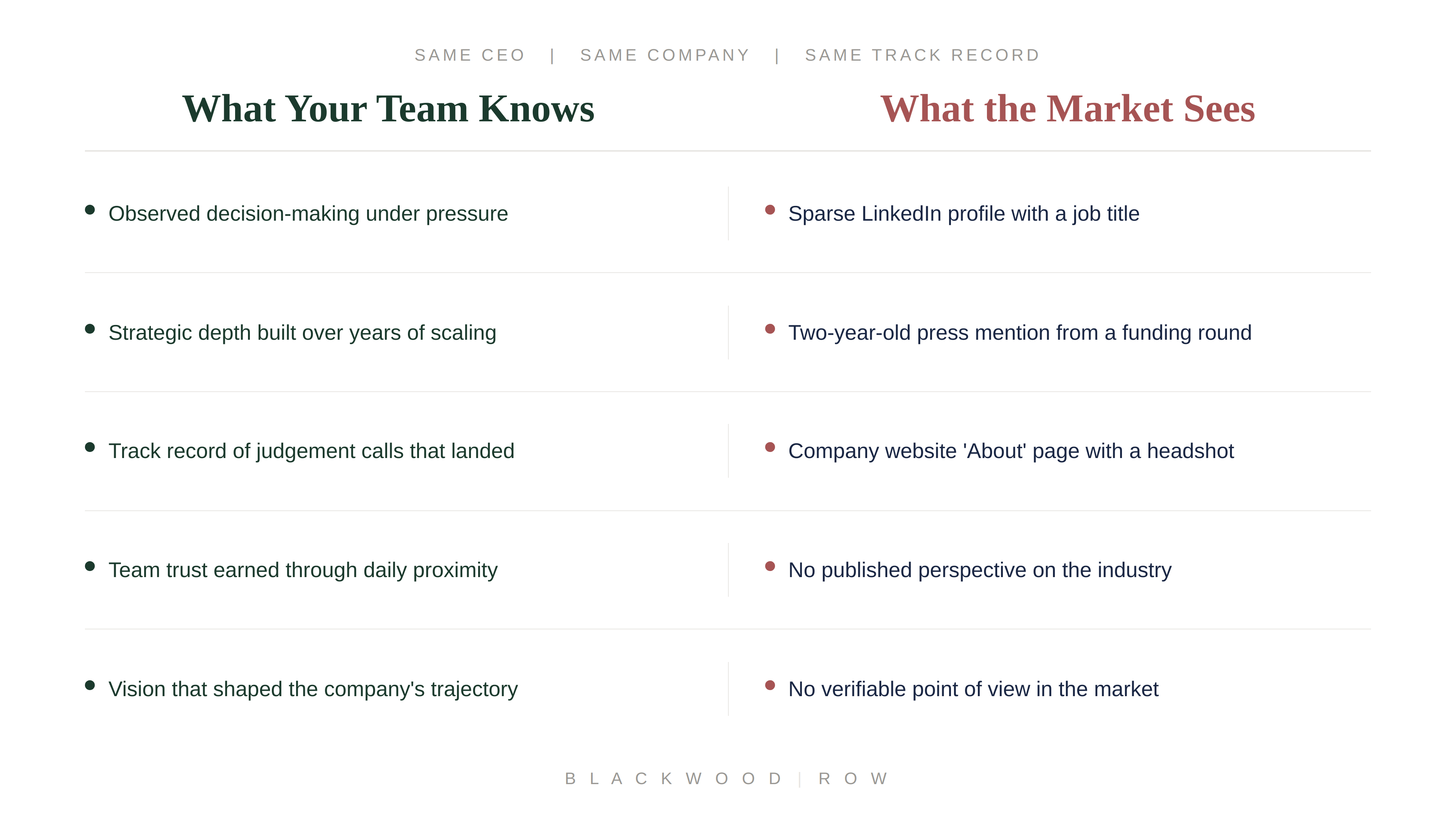
Your team has watched you make decisions under pressure. They've seen you navigate complexity, manage competing priorities, and build something that works. That observed track record is the foundation of their trust.
Nobody outside your company has seen any of it.
An investor, a potential partner, a senior hire, a journalist, an acquirer. They're forming judgements based on what they can observe quickly. That means what shows up in a search, what appears on LinkedIn, what's been published, what's been cited, what other people reference when your name comes up in conversation.
If none of that reflects what you've actually built, they're making the wrong judgement. Not because they're careless or lazy, but because you haven't given them the information required to make the right one.
Authority built in advance compounds. Authority built in crisis looks like what it is.
Weber Shandwick's research found that a strong CEO reputation helps attract employees (77%) and retain them (70%) [2]. The inverse is equally true. Absence of reputation doesn't create a neutral state. It creates an information vacuum that gets filled with assumptions, and assumptions tend to be conservative.
Here's how this plays out in practice. A senior candidate considers joining your company. They search for you. They find your company website, maybe a LinkedIn profile with a job title and a brief summary. They then search for a competitor's CEO. They find published perspectives, a clear point of view on the industry, evidence of strategic depth. The candidate hasn't met either CEO. They've formed a judgement about both. Yours was formed on absence. Theirs was formed on signal.
Why This Compounds Over Time
The compounding effect is the part most CEOs underestimate. The gap between operational reality and external perception doesn't stay static. The company keeps scaling. New capabilities are added. New market positions are established. The CEO's strategic depth continues to develop.
The external signal stays frozen.
Every month the company grows without updated external signal, the gap widens. Every new capability that goes unannounced increases the delta between what the market knows and what's actually true. Every high-stakes conversation becomes marginally harder because the starting point is further from reality.
This creates a specific pattern. Early on, the gap is small enough to correct in conversation. A CEO can spend ten minutes at the start of a meeting establishing context and the conversation proceeds. As the gap widens, that ten minutes becomes twenty. Then thirty. At a certain point, the correction required exceeds what's possible in a single interaction. The CEO finds themselves spending more energy managing perception than having the conversations that actually matter.
The 2024 Edelman-LinkedIn research also found that more than 75% of decision-makers and C-suite executives say that a piece of thought leadership has led them to research a product or service they were not previously considering [3]. That's the positive version. The negative version is what happens when there's no thought leadership at all: that percentage of potential opportunities never surfaces because the signal required to trigger them doesn't exist.
What Needs to Change
The correction isn't about creating more content. It's about building infrastructure that transmits updated signal into the market on an ongoing basis.
The distinction is important. Content is disposable. It has a publication date and a shelf life. Infrastructure is permanent. It creates mechanisms that continue to transmit signal whether the CEO is actively feeding them or not.
Three changes need to happen:
Treat authority as a separate system from operations. Operational performance doesn't automatically translate into market recognition. These are two different systems that require two different types of investment. A CEO who allocates zero resources to external signal infrastructure is making a strategic decision, whether they realise it or not, to let the market form its own conclusions based on outdated information.
Front-load the signal investment before you need it. The worst time to build authority infrastructure is when you're 18 months from an exit, entering a funding round, or trying to close a critical hire. At that point, the gap is already wide enough to cost you. The signal needs to be in place before the high-stakes moment arrives. Authority built in advance compounds. Authority built in crisis looks like what it is.
Design for external observation, not internal satisfaction. The test of effective signal infrastructure isn't whether the CEO feels good about their public presence. It's whether someone encountering them for the first time, with no prior context, can quickly form an accurate assessment of their strategic depth, their institutional value, and their position in the market. If that person has to meet the CEO to understand what they've built, the infrastructure doesn't exist yet.
The Question Underneath Every High-Stakes Conversation
The work you've done is real. The company you've built is real. The strategic depth you've developed through years of operational leadership is real.
The question is whether the market that could reward you for it actually knows what you've built?
Signal Loss at this stage isn't a vanity issue. Neither is it about personal brand, social media presence, or thought leadership as a content marketing exercise. It's a structural vulnerability that sits underneath every high-stakes conversation you'll have from here forward: every exit discussion, every investor meeting, every senior hire, every partnership conversation.
The market makes its own assumptions when there's no clear signal and those assumptions are almost never in your favour.
References
[1] Weber Shandwick & KRC Research, "The State of Corporate Reputation in 2020: Everything Matters Now" (2020). Global survey of 2,227 executives across 22 markets. https://webershandwick.com/news/the-state-of-corporate-reputation-in-2020-everything-matters-now — Primary research quantifying the relationship between corporate reputation and market value.
[2] Weber Shandwick & KRC Research, "The CEO Reputation Premium: Gaining Advantage in the Engagement Era" (2015). Survey of 1,700+ executives across 19 countries. https://webershandwick.com/news/the-ceo-reputation-premium-a-new-era-of-engagement — Primary research on CEO reputation's contribution to company reputation and market value, with findings on talent attraction and retention.
[3] Edelman & LinkedIn, "Reaching Beyond the Ready: 2024 B2B Thought Leadership Impact Report" (2024). Survey of nearly 3,500 management-level professionals across seven countries. https://www.edelman.com/expertise/Business-Marketing/2024-b2b-thought-leadership-report — Primary research on how thought leadership influences B2B buying decisions and vendor evaluation.
[4] Bain & Company, "The Three Most Important Steps in M&A Due Diligence" (2025). https://www.bain.com/insights/the-three-most-important-steps-in-m-and-a-due-diligence/ — Useful for understanding how leading acquirers evaluate leadership quality during diligence; less relevant for pre-exit preparation specifically.
[5] Edelman & LinkedIn, "Invisible Influence: Unlocking the Power of Hidden Buyers, 2025 B2B Thought Leadership Impact Report" (2025). Survey of nearly 2,000 global professionals. https://www.edelman.com/expertise/Business-Marketing/2025-b2b-thought-leadership-report — Primary research on how thought leadership reaches stakeholders who are not in direct contact with sales teams or leadership.