Why Conventional Business Storytelling Advice Fails High-Stakes Leaders (And What to Use Instead)
By Karan Kashyap · Founder, Stay Noisey
Conventional business storytelling advice was designed for consumer brands, optimised for mass audiences, and built on frameworks borrowed from film and television. For CEOs and founders, following that advice creates a specific problem: the narrative you produce doesn’t match the audience making decisions about your business. This article explains why the standard playbook breaks down at the institutional level and introduces a replacement framework built for leaders whose narrative directly affects business valuation, investor confidence, and market position.
What Does Business Storytelling Actually Look Like for High-Stakes Leaders?
Quick Answer: Business storytelling for high-stakes leaders starts with two questions before anything else: who are you talking to, and what do you want to be known for? Everything else, including what you share, how you share it, and what you leave out, flows from those answers. You share only what aligns to those answers. Not everything. Not your life story. Not your vulnerabilities. Just the things your specific audience needs to understand about you to make the judgment you need them to make.
This is a narrower, more deliberate, more clinical process than conventional storytelling advice suggests. It focuses on being legible to the right people, for the right reasons, at the right time.
For a CEO whose primary audience is institutional investors, the narrative must demonstrate pattern recognition and judgment under pressure. For a founder selling to enterprise clients, the narrative must reframe the buying criteria, so the market evaluates on your terms.
Both require a completely different approach, but conventional storytelling advice treats them all the same.
The Science Is Sound. The Application Is Not.
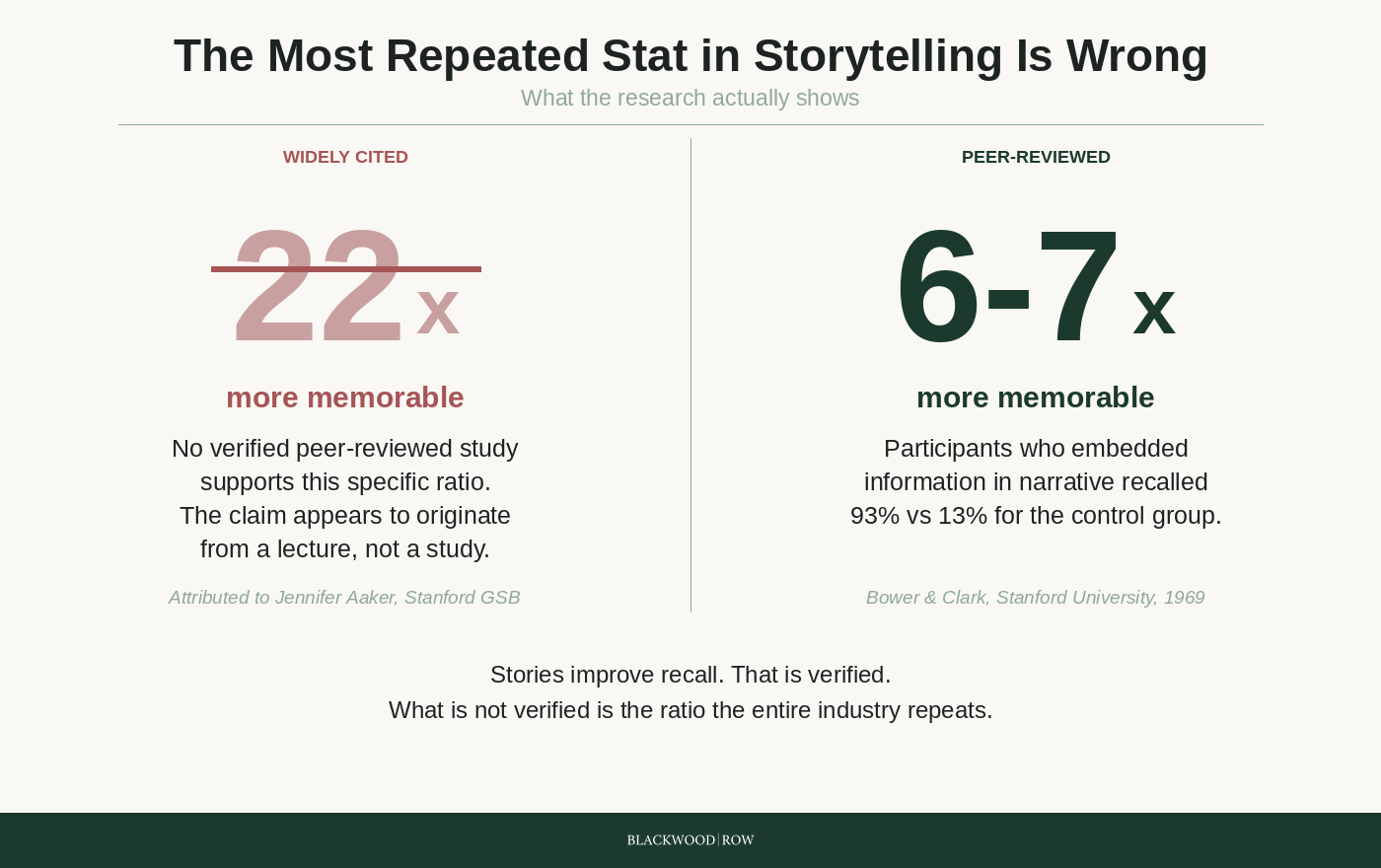
Stories do improve information retention. That much is well established. You will find the claim repeated across business literature that stories are “22 times more memorable than facts alone,” typically attributed to Stanford’s Graduate School of Business or cognitive psychologist Jerome Bruner [1].
The figure is almost certainly wrong.
Multiple independent investigations have failed to trace the “22 times” claim to any verified peer-reviewed study. It appears to originate from a lecture by Stanford marketing professor Jennifer Aaker, but no published methodology supports the specific ratio [2]. The actual experimental evidence, from Bower and Clark’s 1969 study at Stanford, found that participants who embedded information in narrative recalled six to seven times more than a control group, with average recall scores of 93% versus 13% [3].
Six to seven times is still a substantial effect. It validates that narrative structure improves how people process and remember information. What it does not validate is the industry that has grown up around that principle, which has taken a cognitive science finding about memory and turned it into a set of performance instructions for leaders operating at a completely different level.
The research tells us narrative structure matters, but it says nothing about which narrative, for which audience, or toward which commercial outcome.
Where Conventional Storytelling Advice Actually Comes From
The frameworks most consultants, agencies, and coaches teach trace directly to film, television, and consumer brand narrative. Hero’s journey. Emotional arc. Vulnerability as a connection mechanism. Character, conflict, resolution.
These were built to move mass consumer audiences. People buying trainers. People choosing between streaming services. People deciding which supermarket to visit. They are optimised for broad emotional resonance and attention capture at scale.
That is a completely different job from what a CEO or founder needs their narrative to do.
I know this because I have worked both sides. Before building a narrative infrastructure consultancy, I produced documentaries for The Premier League and I conducted psychometric interviews with Area Vice Presidents and Managing Vice Presidents at Gartner, one of the world’s largest research and advisory firms.
In documentary production, the job was emotional resonance. You build character arcs. You create tension and release. You make the audience feel something about the subject. The entire framework is designed to hold attention across a broad viewership and produce an emotional response. It works because it is built for that purpose.
At Gartner, the job was completely different. I sat across from executives whose authority was institutional, not personal. Their audiences were boards, analysts, and enterprise clients making purchasing decisions worth millions. When these leaders communicated externally, the mechanism that created trust was not emotional arc or personal vulnerability. It was the quality of their thinking, the precision of their market read and the evidence that they saw patterns others missed.
The storytelling techniques that produced exceptional documentaries would have been actively counterproductive in that environment. And the communication patterns that made corporate professionals credible to their institutional audiences would have made terrible television. These are two different disciplines with two different objectives., but the industry treats them as one.
The Edelman-LinkedIn 2024 B2B Thought Leadership Impact Report, surveying nearly 3,500 management-level professionals, confirms the gap. 73% of decision-makers consider thought leadership more trustworthy than marketing materials [4], 75% said thought leadership led them to research a product or service they were not previously considering, and 70% of C-suite executives said it led them to reconsider an existing vendor [4]. This audience evaluates credibility through demonstrated expertise and institutional judgment. Emotional storytelling techniques designed for consumer attention do not register.
For high-stakes leaders communicating externally, the trust mechanism is not vulnerability, it is demonstrated judgment.
The Question Nobody Asks First
Before any high-stakes leader considers what to share, they need to answer who they are talking to. This is the fundamental question conventional storytelling advice skips entirely. It defaults to share broadly, reach everyone, be relatable.
A CEO talking to investors needs completely different signal from a CEO building a commercial audience for a book. A founder talking to enterprise clients needs different framing from a founder attracting top engineering talent.
When you try to speak to everyone, you calibrate for no one. The story becomes generic, so the signal becomes noise.
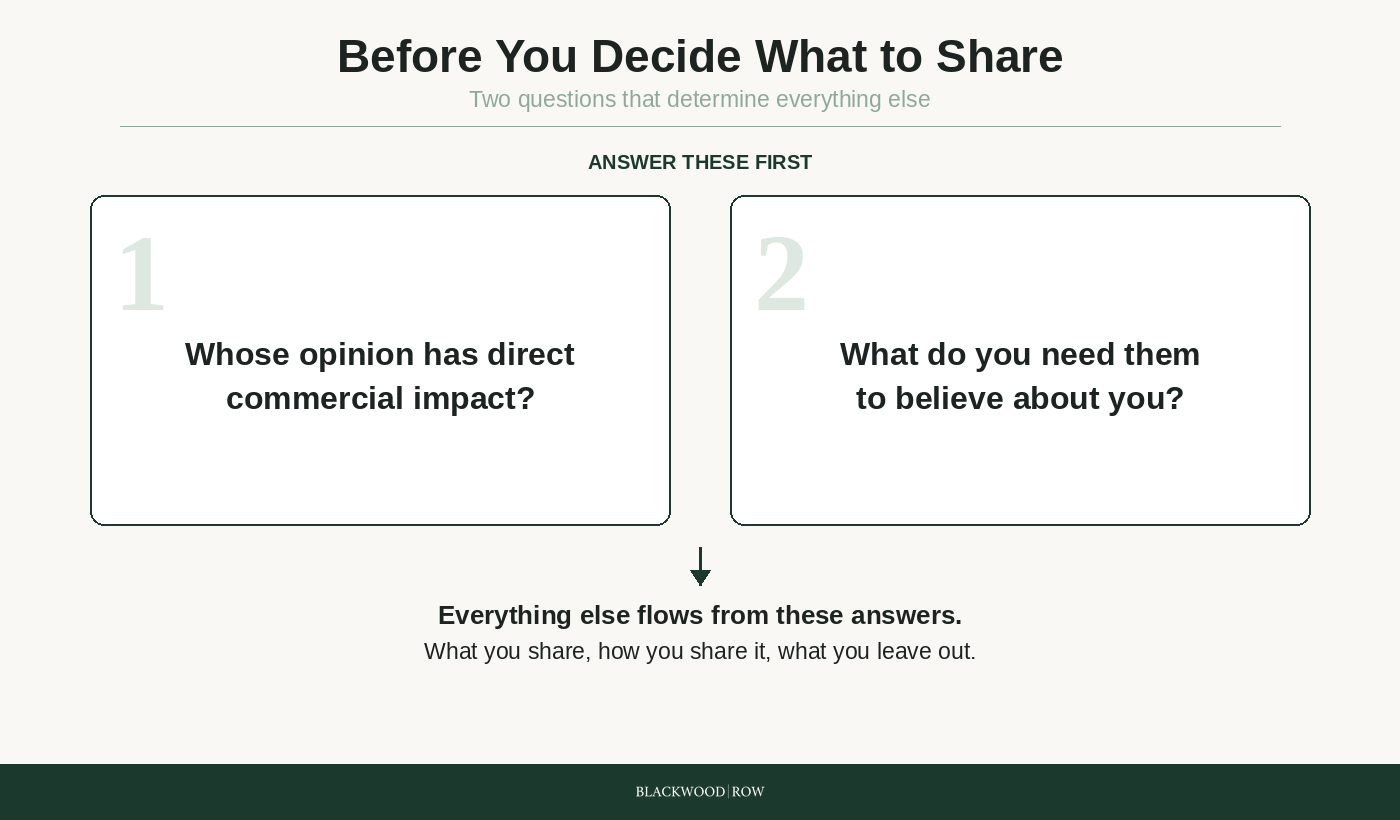
Storytelling for high-stakes leaders starts with two decisions before anything else:
1. Who is the specific audience whose opinion has direct commercial impact on your business?
2. What do you want that specific audience to believe about you, and what evidence would make that belief rational?
Everything else flows from those answers.
The Vulnerability Trap
Vulnerability became the dominant advice in the personal branding space around 2014, driven largely by Brené Brown’s research and popularised through TED talks, bestselling books, and an industry of coaches and consultants who adopted it wholesale.
Within organisations, there is evidence that leader vulnerability builds team trust. DDI’s Global Leadership Forecast 2023, surveying over 13,000 leaders globally, found that only 32% of leaders trust senior leaders in their organisation. The same research indicated that employees are 5.3 times more likely to trust leaders who regularly show vulnerability [5]. This is a finding about internal team dynamics. It says something real about how leaders should show up with their direct reports.
It says almost nothing about how leaders should show up in external narrative.
The vulnerability advice has been extracted from its original context, which was interpersonal team leadership, and applied to external-facing narrative aimed at investors, enterprise buyers, board members, and industry peers. These are audiences making high-stakes assessments about capability, not looking for emotional connection.
For a leader whose primary audience is institutional investors, performative vulnerability does not build authority. It can actively undermine it. The question is not “how open can you be?” It is “what does your specific audience need to believe about you, and what information serves that belief?”
For high-stakes leaders communicating externally, the trust mechanism is not vulnerability, it is demonstrated judgment.
What the CAR Framework Gets Right and What It Misses
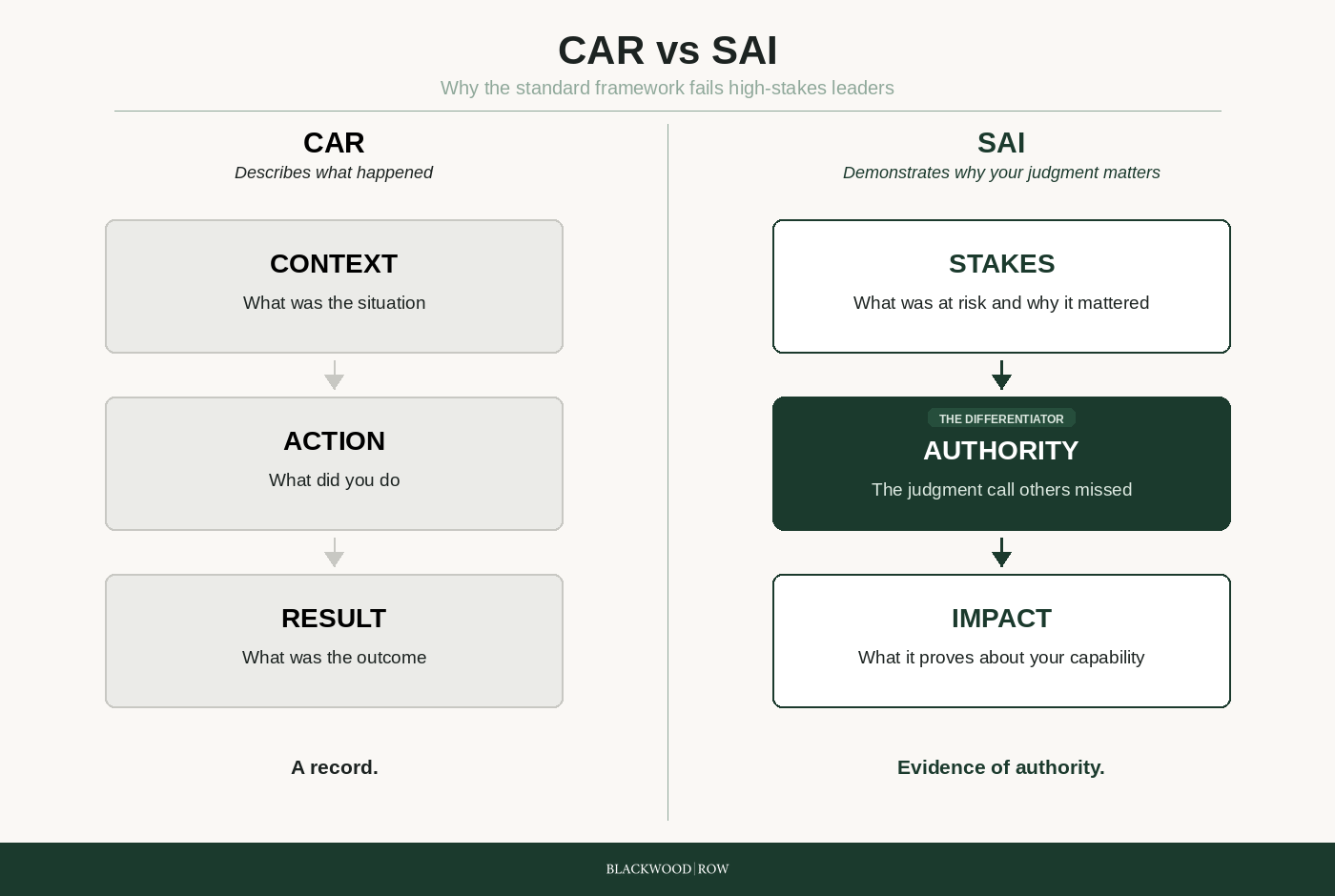
CAR, which stands for Context, Action, Result, gets cited regularly in business communication training. It is a functional framework for describing what happened and it works for case studies and job interviews, but it does not build authority.
The reason is that CAR leaves out the single most important element: judgment. The thinking behind the action. The pattern recognition that led to the decision. The reason this particular leader saw what others did not.
Anyone can describe context, action, and result. A competent operations manager can do it, a junior project lead can do it, but what separates a high-stakes leader’s narrative from a capable operator’s narrative is the quality of judgment in between.
CAR produces a record, it does not produce evidence of authority, and for leaders whose narrative needs to demonstrate why their judgment is worth following, that distinction is the entire gap.
The SAI Framework: Stakes, Authority, Impact
SAI replaces CAR with a framework built specifically for high-stakes leadership narrative. It is designed to produce evidence of judgment, not just a description of events.
1. Stakes: What was actually at risk. Not just the context, but the weight of the situation. Why this moment mattered and what failure would have cost. This immediately separates high-stakes leadership narrative from generic business storytelling. SAI starts with pressure.
2. Authority: The judgment call. What you saw that others did not. The decision you made and the thinking behind it. The pattern you recognised. This is the differentiating element CAR ignores entirely. It demonstrates how you think, not just what you did.
3. Impact: The institutional significance. Not just the result, but what the result proves about your capability as a leader. The difference between “revenue increased 40%” and “this decision restructured how the market evaluated the problem.” Impact in SAI is always connected back to the leader’s judgment.
SAI Applied: A Worked Example
Consider a SaaS founder preparing for a Series B pitch. Using CAR, they might say:
“We noticed enterprise clients were churning after six months (Context). We rebuilt the onboarding process and added a dedicated success team (Action). Retention improved by 35% over two quarters (Result).”
Functional and competent, but entirely forgettable. Any capable operator could have described the same sequence.
Using SAI, the same founder says:
“We were losing enterprise clients at a rate that would have made our Series A metrics meaningless within eighteen months. The board wanted to fix the product, sales wanted to fix pricing, but I looked at the data differently: the clients who churned had the highest initial engagement scores. They were not leaving because the product failed. They were leaving because they outgrew the value prop we sold them in month one. We restructured the entire post-sale relationship, not onboarding, but the ongoing narrative of what the platform could become for them. Retention improved by 35%, but the real shift was that enterprise deal sizes increased by 60% because clients started buying the roadmap, not just the current feature set.”
An investor hearing the first version is evaluating a metric. An investor hearing the second is evaluating judgment.
Why the Stakes Are Higher for This Specific Audience
High-stakes leaders have more to lose from getting narrative wrong than anyone else. Their narrative directly affects business valuation, investor confidence, talent acquisition, partnership terms, and exit positioning.
The 2024 Edelman-LinkedIn research found that only 15% of decision-makers rated the overall quality of thought leadership they consume as “very good” [4]. The bar is low. The opportunity is significant. But only for leaders producing signal that matches what this audience actually evaluates.
Their peers, the people whose opinion matters commercially, do not need them to be relatable. They need them to be credible, clear, and authoritative.
SAI is built for external positioning: investor pitches, enterprise sales, published thought leadership, keynote presentations, board communications. It is not designed for internal team communication, where psychological safety and openness matter more, and it is not a framework for pre-product-market-fit founders talking to other founders and angel investors. SAI becomes relevant when the stakes of narrative increase, typically Seed to Series A and beyond, where the audience shifts from enthusiasts to institutional evaluators.
Frequently Asked Questions
What is business storytelling for CEOs?
Business storytelling for CEOs is a clinical process of identifying a specific audience, determining what that audience needs to believe, and structuring narrative that provides evidence for that belief. It starts with audience and purpose, not with the leader’s personal story. The goal is accurate recognition by a precise audience, not broad connection with a general one.
Why does conventional storytelling advice fail for CEOs and founders?
Conventional advice borrows from consumer brand narrative and film structure, which are optimised for mass emotional resonance. CEOs and founders operate in environments where the audience is small, analytical, and making high-stakes commercial decisions. Applying B2C storytelling logic to B2B leadership narrative produces content that feels performative and fails to demonstrate the judgment these audiences are evaluating.
Is vulnerability effective in executive communication?
Vulnerability is effective in internal leadership contexts where the goal is psychological safety and team trust. It is generally counterproductive in external positioning contexts where the audience is evaluating competence, judgment, and institutional capability. The research supporting vulnerability in leadership (such as DDI’s Global Leadership Forecast) studied internal team dynamics, not external market narrative [5].
How should a founder approaching Series B think about narrative?
A founder at Series B needs narrative that positions them as a category owner, not a feature competitor. The narrative should demonstrate that the founder sees a market problem differently from everyone else, has made judgment calls that validate that perspective, and has produced institutional outcomes that prove the thesis. SAI provides the structure: what was at risk (Stakes), what the founder saw that others missed (Authority), and what happened as a result (Impact).
What is the first step in building leadership narrative?
Identify the specific audience whose opinion has direct commercial impact on your business and determine what you need that audience to believe about you. Before deciding what to share, you need clarity on who you are talking to and what outcome the narrative is meant to produce. Without those answers, any storytelling framework will produce generic content.
References
[1] Aaker, J. “Harnessing the Power of Stories.” Stanford Graduate School of Business, VMware Women’s Leadership Innovation Lab.
[2] Patience-Davies, H. (2024). “Just where did the claim that stories are 22 times more memorable than facts alone come from?” LinkedIn.
[3] Bower, G.H. & Clark, M.C. (1969). “Narrative stories as mediators for serial learning.” Psychonomic Science, 14, 181-182.
[4] Edelman & LinkedIn. (2024). “Reaching Beyond the Ready: 2024 B2B Thought Leadership Impact Report.” Survey of 3,484 management-level professionals across seven countries.
[5] DDI. (2023). “Global Leadership Forecast 2023.” Survey of 13,695 leaders and 1,827 HR professionals from 1,556 organisations globally.